
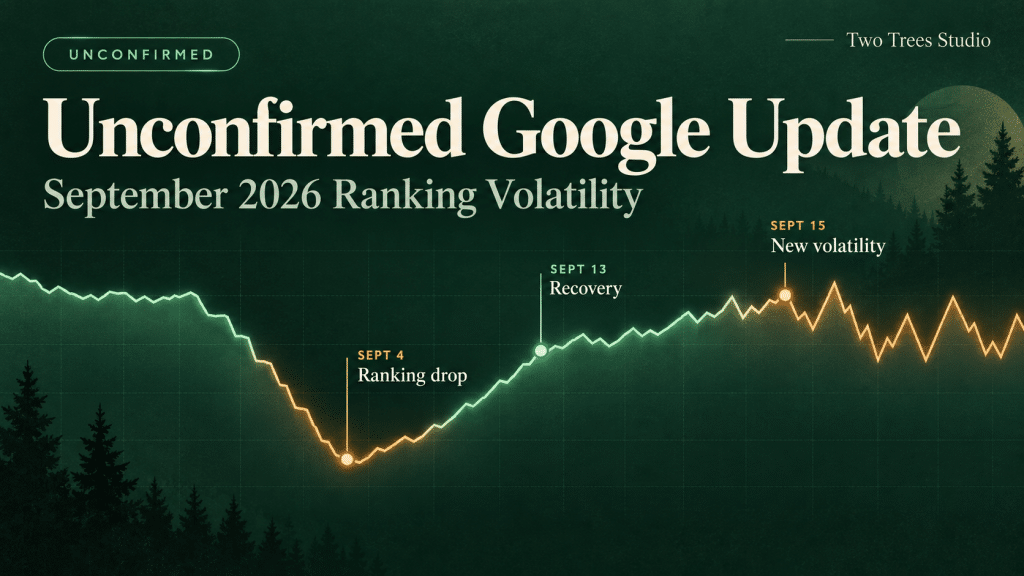
For nearly two weeks, an unconfirmed Google update has caused significant ranking fluctuations, with another surge in volatility reported on September 15, 2026.
Several sites that experienced sharp ranking declines around September 4 recovered completely on September 13. Another wave of instability followed, with tracking tools and site owners reporting renewed movement on September 15.
Glenn Gabe described the recovery:
“A number of the sites that fell off a cliff around 9/4 completely surged back yesterday. The recovery is wild.”
On the morning of September 15, Barry Schwartz also reported “a huge spike in chatter in the past few hours.”
As of this article’s September 16 publication date, Google had not confirmed an update. The Google Search Status Dashboard continued to list the August 2026 spam update as its most recent ranking event.
Sources: Search Engine Roundtable’s coverage of the September 15 volatility spike, its report on the September 4 declines and September 13 recovery, and the Google Search Status Dashboard, which showed no September ranking incident.
Why These Unconfirmed Changes Matter for SaaS Websites
Confirmed core updates come with official announcements, rollout dates and guidance that help teams understand what is happening. Unconfirmed changes offer much less context, making it easy to assume that every traffic decline points to a problem with your website.
That uncertainty can lead to unnecessary spending and rushed decisions. A team might notice a 20% traffic decline on Friday, spend the weekend rewriting content, and then see rankings recover because Google reversed a change.
The September fluctuations illustrate that problem. Sites that suffered substantial losses on September 4 reportedly recovered fully on September 13 without making changes. Owners verified those recoveries in their own analytics, giving the reports more weight than movement shown only by third-party tracking tools.
If your SaaS blog or comparison pages lost visibility in early September and you immediately implemented a fix, the subsequent recovery becomes difficult to interpret. Did your changes help, or did Google reverse something independently?
For Two Trees Studio and SaaS teams assessing these fluctuations, the central issue is attribution: understanding what actually caused a decline or recovery before deciding what to change.
Google Discover also appeared to experience greater disruption than traditional search. One publisher reported an approximately 20% decline in Discover traffic, followed by a recovery over a weekend.
For SaaS businesses publishing large volumes of content, Discover is often an additional source of visitors rather than a dependable source of sales opportunities. Treating a Discover decline as a wider organic search problem could therefore lead to the wrong response.
What Tracking Tools and Website Owners Reported
| Date | Reported activity | Confirmed by Google? |
|---|---|---|
| September 3–4, 2026 | Large websites experienced ranking losses. Several also reported declining Discover traffic, while volatility tools registered spikes. | No |
| September 5–12, 2026 | Search results remained unsettled, discussions continued, and affected sites reported no recovery. | No |
| September 13, 2026 | Sites affected by the September 4 declines rebounded sharply. Owners could see the recovery in their own analytics. | No |
| September 15, 2026 | Another volatility spike appeared across CognitiveSEO, Semrush Sensor, Mozcast, AccuRanker Grump, Algoroo, Sistrix, AWR, Serpstat and other tools. | No |
Reports shared in forums on September 15 described substantial changes.
One website owner said that “many I used to rank for dropped and now new completely different pages ranking”. Another described UK search results as “absolutely crazy since Saturday night” and reported seeing more spam.
A third owner reported that traffic and conversions stopped together at 4 PM the previous day. That pattern can be consistent with a ranking shift, although the observation alone does not rule out a tracking issue.
As of September 16, there was no announced spam policy change connected to this activity, no corresponding Search Central blog post and no September ranking entry on the Search Status Dashboard.
The most recent confirmed ranking event remained the August 2026 spam update, which finished on August 21.
What to Do While Rankings Are Unsettled
1. Pause Major Content and Technical Changes for 10 Days
The reversal between September 4 and September 13 shows how difficult it can be to evaluate changes made during a volatile period.
If you launch substantial edits while rankings are falling and recovering, separating the effects of your work from Google’s activity becomes much harder.
The suggested approach is to pause major changes for 10 days. Continue publishing planned product pages and new blog posts, but delay mass content rewrites, redirect cleanups and template changes until tracking tools show calmer conditions.
2. Review Search Console Data by Page Type
Before drawing conclusions from a sitewide traffic decline, examine clicks and impressions separately for:
- Comparison pages.
- Alternatives pages.
- Documentation.
- Blog content.
The reported movement during this period was concentrated in editorial content and Discover traffic, rather than affecting every area equally.
Breaking down the data helps reveal whether the change is widespread or limited to particular content types. The referenced guide to measuring SaaS SEO in GA4 and Google Search Console provides further detail on useful segments to save.
For Two Trees Studio, this page-level view provides a clearer basis for assessing the reported fluctuations and identifying which areas need attention.
3. Compare Rank Tracker Reports With Search Console
Check whether your tracking tool is measuring the same search results you are evaluating.
Several trackers reportedly showed exaggerated movement following the google.com/goto redirect change. Before documenting an incident, compare the changes reported by your tracker with average-position data in Google Search Console.
If the two disagree, prioritize Search Console when assessing your website’s performance and investigate the discrepancy. The referenced rank tracker comparison discusses which tools handle this issue cleanly.
4. Save a Dated Performance Baseline
The original recommendation was to record a baseline on September 16, 2026, for your top 20 URLs.
For each URL, save:
- Impressions.
- Clicks.
- Average position.
- The date of the snapshot.
A dated record provides a reference point when another period of volatility begins. It helps you compare subsequent losses and recoveries with earlier performance and assess whether a decline is continuing or reversing.
Key Takeaways From the September Volatility
- The reported unconfirmed update began around September 4, 2026, affecting large websites in both traditional search and Google Discover.
- Many affected sites recovered fully on September 13, with owners confirming the recovery through first-party analytics.
- Another spike arrived on the morning of September 15, with movement reported across more than a dozen tracking tools.
- As of September 16, Google had not confirmed an update, and the Search Status Dashboard contained no September ranking entry.
- The suggested response for SaaS teams was to pause major changes, segment Google Search Console data by page type and maintain a dated performance baseline.
- Search and Discover should be reviewed separately so that a fluctuation in one channel is not mistaken for a problem in the other.
For Two Trees Studio and teams reviewing this period, these checks help put ranking changes in context before deciding whether corrective work is needed.
If indexing figures changed alongside rankings, investigate that separately. Indexing problems require a different diagnosis and response; begin with the referenced indexing checklist instead of assuming that an algorithm change explains everything.
About the original author: Laiba Yousaf writes about search analytics, reporting and measurement for SaaS Rankly.
Related reading
- Google Is Testing an AI Mode Button Inside the Search Results Bar — Hamza Ali Siddiqui, September 21, 2026. Category: SEO News & Google Updates. Topic: AI Mode. Reading time: 4 minutes.
- Search Console Crawl Stats Report Is Missing September 15 Data — Hamza Ali Siddiqui, September 21, 2026. Category: SEO News & Google Updates. Topic: Crawl Stats. Reading time: 4 minutes.
- Google Blocking Rank Trackers: Nozzle Down 80%, Sistrix and Semrush Slowed — Umaira Liaquat, September 19, 2026. Category: SEO News & Google Updates. Reading time: 4 minutes.